Tween Moods: When to Worry, When Not To.
Wings Team
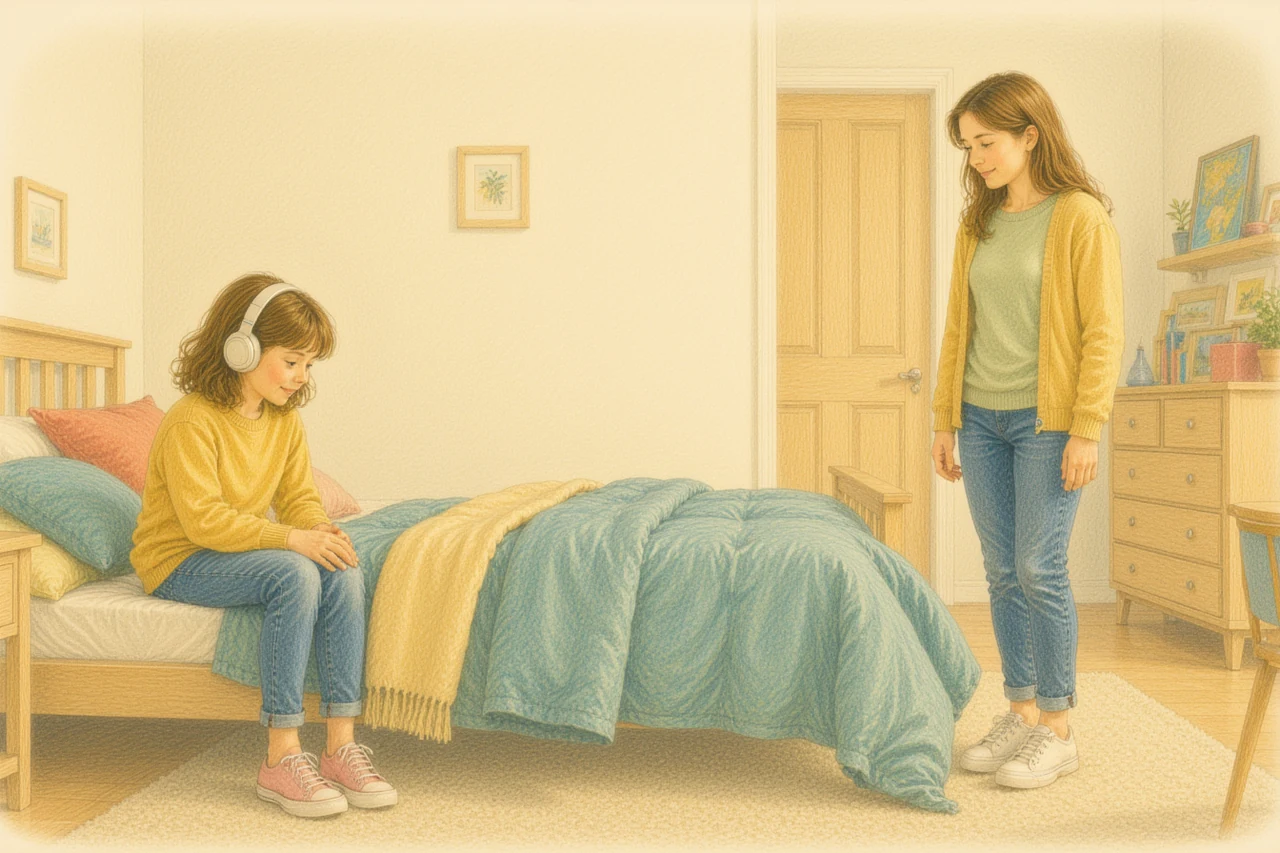
Laughing in the morning, slamming a door by afternoon, answering "how are you?" with "leave me alone." At 10–13, mood swings, withdrawal and "prickliness" scare parents: is something wrong with my child? Most often – no. This is a normal part of growing up, not a breakdown and not your fault. Let's look honestly, based on research, at why this happens, what opens up in thinking at this time – and how to calmly tell ordinary teen gloom from the signs worth seeing a professional about. One caveat up front: this is not a diagnosis, but about when it makes sense to ask a doctor a question.
In short: why a tween is so "stormy"
From roughly 10–13, the brain's emotional and "reward" system becomes more sensitive earlier than the self-control system matures. Add puberty and a sleep shift. Hence – strong emotions, a pull toward novelty and peer approval, withdrawal and mood swings. This is reorganization, not a defect: alongside the vulnerabilities, new abilities of thinking are growing too. Normal here is a wide range; the timing differs for everyone.
Why so many emotions: the brain is reorganizing, not breaking
The leading explanation is the "dual-systems" model (Steinberg; Casey and colleagues). Two systems mature at different rates: the emotional-reward system becomes more reactive early, around the start of puberty, while the control system (planning, impulse inhibition) matures gradually, over years. The gap between them – when emotions and sensitivity to rewards have "switched on" while the brakes are still maturing – is what produces stronger feelings and mood swings.
Two honest caveats:
- This is the leading but debated model – some scientists consider the split into "two systems" an oversimplification. So we present it as the best explanation, not a "proven fact."
- The common line that "a teen's brain is underdeveloped / broken, so they don't think" is an overstatement. It is more accurate to say not "no control," but "emotions are for now more reactive relative to control." As Ronald Dahl puts it, adolescence is a period of both vulnerabilities and opportunities, not broken years.
Puberty and sleep: two concrete "whys"
Puberty arrives across a wide, normal range. In girls roughly 8–13, in boys 9–14 – both earlier and later within these bounds are normal, and much of it runs in the family. Hormonal changes make rewards, novelty and peer acceptance more "vivid" and charged.
A sleep shift is a common cause of irritability. With the start of puberty, melatonin production shifts 1–3 hours later: a teen biologically does not want to sleep earlier and gets up hard in the morning. This is biology, not laziness. Early school start times hit against this shift, sleep debt piles up – and that directly increases irritability and gloom. The practical takeaway is reassuring: part of the "mood" is simply lack of sleep, and that can be worked on (pediatricians even recommend that schools start no earlier than 8:30).
Emotions and the social world: why "leave me alone" and a closed door are normal
The American Academy of Child and Adolescent Psychiatry (AACAP) directly places within normal early-adolescent development: mood swings; feeling awkward about themselves and their body; heightened attention to appearance and peer acceptance; "less open affection toward parents, sometimes rudeness"; complaints that parents interfere with their independence.
What lies behind this:
- Peers move to the foreground, and sensitivity to how you are judged grows. The psychologist Elkind described this as the "imaginary audience" – the feeling that everyone is watching and judging you.
- The search for self (in Erikson's terms – "identity versus role confusion"): the task of this age is to assemble one's own "I," hence the pull toward autonomy, testing limits, moving toward peers. A closed door, a wish for privacy, "negotiating" closeness – this is expected, not a rejection of you.
What opens up in thinking
Around 11–12, what Piaget called formal-operational thinking begins: the ability to reason about the abstract and hypothetical ("what if…"), to think more systematically, to think about fairness, morality, ideas – not only about concrete objects. Metacognition (thinking about one's own thinking) develops, along with the ability to see shades of meaning and to argue.
A crucial honest caveat – and it is precisely an argument for practice: this kind of thinking is not universal and does not "switch on all at once." Many teens (and adults) apply it inconsistently, especially in unfamiliar or abstractly framed tasks. It develops as a continuum and requires support and practice – it does not arrive ready-made. (Hence "teen idealism" too: a newcomer to abstractions sometimes confuses "possible in theory" with "real in practice" – this is sweet and normal, not a flaw.)
What is best to support right now
By this age, areas "come alive" that are easy to unlock through open-ended tasks with no single right answer. This is exactly what we lean on when preparing Wings tasks for a tween:
- The abstract and hypothetical – "what would happen if we changed one rule of the world?"
- Arguing from different sides – defend a position you don't share yourself; find the strongest counterargument.
- Moral dilemmas – situations with no clean answer: fairness, compromises, conflicts of values (shades, not "right/wrong").
- Evaluating sources and claims – where is the fact, where is the opinion, where did it come from, where are you being manipulated (early media literacy).
- Metacognition and self-reflection – "how did I arrive at this conclusion?", noticing one's own assumptions and emotions (this also helps with self-regulation).
- Systematic problem-solving – sketch out and test options, think through consequences (supports that very control system that is still maturing).
All of this is an invitation to think, not pressure and not "right answers."
When it's worth paying attention (calmly and without diagnoses)
The main point up front: this is not a checklist for self-diagnosis. Ordinary gloom and a genuine problem are a continuum, and only a professional can assess it. The value of these signs lies in one thing: understanding when it makes sense to talk to a pediatrician. You know your child's "baseline" better than anyone.
Ordinary mood is usually tied to a reason, passes within a couple of days, and does not cancel the ability to feel joy when circumstances change.
It's worth seeing a professional if the changes are:
- Persistent – low mood, irritability or sadness for most of the day, almost every day, two weeks or longer, and not letting up even when something good happens.
- Pervasive – at home, at school, and with friends, not in one single situation.
- Impairing – grades drop, friends drift away, sleep and appetite change, interest in what they used to love disappears.
- A shift from "their normal" – important: in teens, depression often looks like irritability and anger rather than classic sadness, and it can mask itself as bodily complaints (head, stomach).
Don't wait, seek help promptly if there is any talk of hopelessness, worthlessness, self-harm or not wanting to live. This is the case where it's not "wait and see," but straight to a pediatrician, a psychologist/psychiatrist, or a local emergency mental-health line.
A couple of honest clarifications: the "two weeks" threshold is a clinical rule of thumb (from the diagnostic criteria), not a verdict; and safety signals (thoughts of self-harm) override any "wait." And always: if something isn't letting up – asking a doctor is normal, it is not "overreacting."
Frequently asked questions
My teen has become rude and closed off – am I losing them? Probably not. Less open affection, privacy and "leave me alone" are on the list of normal early-adolescent development. This is about autonomy and the search for self, not about rejecting you. It helps to be present without pressure and not to take the prickliness personally.
Mood swings – is this hormones already, or something serious? More often – normal reorganization (brain + puberty + lack of sleep). What should raise concern is not "bad mood in general," but a steady pattern: two weeks or longer, pervasive, with harm to daily life (see the block above).
They sleep till noon on weekends and won't get up for school. Are they being lazy? This is biology: with puberty the "sleep clock" shifts later. Early morning light, a routine, and reasonable limits on screens in the evening help – but you can't "reset" the internal clock by willpower.
Should I push so they "get serious"? Pressure usually hits motivation. Abstract thinking is only maturing and needs support, not demands. It's better to invite them to reason and argue than to insist on the "right" conclusions.
When is it definitely time for a professional? Immediately – at any words about hopelessness or a wish to harm themselves. And it's worth being seen if low mood/irritability lasts two weeks or longer, is pervasive and interferes with life. The first address is a pediatrician: they will assess and, if needed, refer you.
How Wings helps
Wings gives one short task a day, matched to the child's age (2–14). For a teen they lean on exactly what is maturing now: to reason about "what would happen if," to argue from different sides, to work through a dilemma with no ready answer, to check a source, to trace one's own line of thought. No right answer and no pressure – we look not at "right/wrong" but at the quality of reasoning, and this gently trains that very control system that is still maturing.
But, honestly, the main thing here is not the tasks themselves, but the habit of thinking and talking together a little every day. If it took shape back at ages 2–6, then by the teen years you already have a calm, familiar channel of communication – and the changes we talked about above are easier to read. A child who has been used to naming their thoughts and feelings from an early age is usually a bit more willing to share at 13, too – rather than just slamming the door. This is not "insurance against a hard puberty" (there is no such thing), but rather a head start: it is easier for you to understand what is happening with them, and for them to understand themselves. Five minutes a day, no screen. Try it free →
Sources
- Steinberg, L. (2010). "A Dual Systems Model of Adolescent Risk-Taking." Developmental Psychobiology DOI · PubMed; Shulman, E. P., et al. (2016). "The dual systems model: Review, reappraisal, and reaffirmation." Developmental Cognitive Neuroscience DOI · PMC. (Different maturation rates of the emotional and control systems; the model is leading but debated.)
- Casey, B. J., Jones, R. M., & Hare, T. A. (2008). "The Adolescent Brain." Annals of the New York Academy of Sciences DOI · PubMed.
- Dahl, R. E. (2004). "Adolescent Brain Development: A Period of Vulnerabilities and Opportunities." Annals NYAS DOI · PubMed; Peper, J. S., & Dahl, R. E. (2013). "The Teenage Brain: Surging Hormones." Current Directions in Psychological Science.
- AACAP – "Normal Adolescent Development" (mood swings and less affection toward parents are normal); "The Depressed Child"; "Teen Suicide." (Normal development and the signs that call for help.)
- American Academy of Pediatrics – recommendations on school start times for teens (2014) and on normal puberty; National Sleep Foundation – teen sleep (the melatonin shift).
- NIMH – "Teen Depression." Official guidance (Signs, duration, where to turn.)
- Piaget, J. – the formal-operational stage (~from 11–12); with the modern caveat: not universal, develops as a continuum, requires practice.
- Erikson, E. – "identity versus role confusion"; Elkind, D. – the "imaginary audience" (adolescent egocentrism).
Updated: July 2026.
Try Wings free
Free trial, then a monthly subscription.