What's Normal at 4 (and What Isn't).
Wings Team
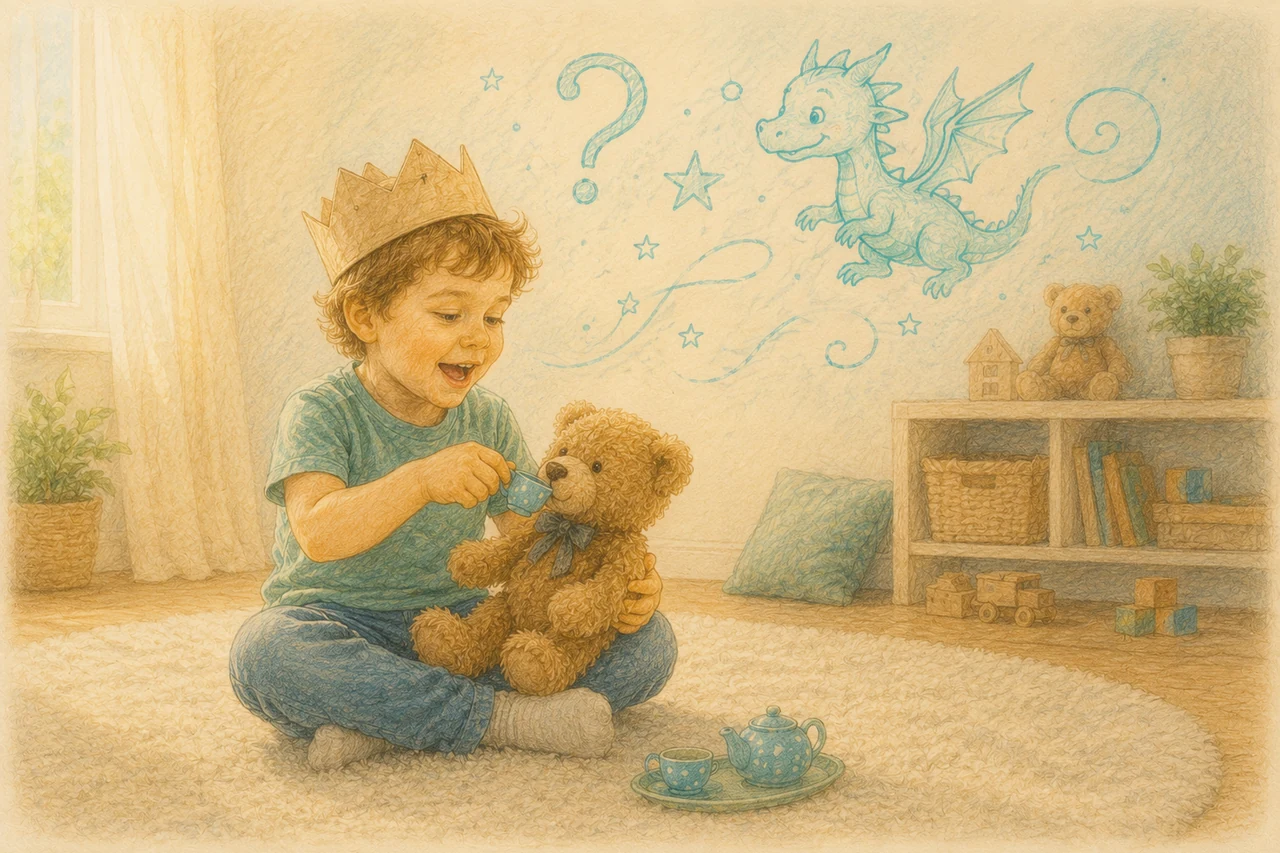
Let's agree on the main thing up front: everything below is about ranges, not deadlines. "Normal at 4" is a very wide field, and two equally thriving children can be at opposite ends of it. We won't say "your four-year-old should…". Instead, honestly and based on research, we'll look at which areas of thinking and knowledge usually open up around age four, what's most useful to support at this time, and what's worth calmly keeping an eye on.
In short: the main points about age 4
Around four years old, a lot of new things "open up" for a child: they begin to understand that another person can think differently, they bury you in "why" questions, they play out complex pretend storylines, they continue stories, they try sorting the world into groups. At the same time, logic, self-regulation, and the ability to share are still maturing – and that's also normal. The key point: this is not a list of things they "should be able to do," but windows in which it's easiest to support thinking – gently and through play.
The main rule: "normal" is a range
Even official guidelines moved away from checklists long ago. Since 2022, the CDC ("Learn the Signs. Act Early.") frames milestones not as "the average child can," but as "about 75% of kids do this by such-and-such age." In other words, it's built in that a noticeable share of children reach the same point later – and that's still normal. Keep this in mind every time you read any list of "at 4 a child can."
And one more thing: Piaget, a classic of developmental psychology, in many ways underestimated young children. When his tasks are simplified and the confusing language is removed, preschoolers manage things he considered beyond them. So even the "stages" are about order and tendencies, not dates in a passport.
What opens up in thinking around four
Understanding that another person thinks differently (theory of mind). This is perhaps the main cognitive event of the age. A large meta-analysis (Wellman, Cross & Watson, 2001) showed that somewhere between 3 and 5 years old children shift from "consistently don't understand" to "consistently understand" that a person can hold a false belief (think something that doesn't match reality). The peak of the transition is around four. If your child at 4 doesn't yet "get" this, they're squarely within the normal range: the door is only just opening. Recent cross-cultural work (Petrović et al., 2026) confirms and refines this: this "metarepresentational" shift emerges consistently across very different cultures – even though the exact timing varies between peoples ("unity amid diversity").
Endless "why" questions. This isn't pestering, it's thinking in action. In one study (Frazier, Gelman & Wellman, 2009) preschoolers were satisfied and asked follow-ups when an adult gave a real explanation, and asked again when there was no explanation. That is, "why?" is a genuine search for causes. How you answer matters. A recent review (Legare, 2024) adds a nuance: the peak of "why" falls precisely in the preschool years, and by school age the hunger for explanations noticeably fades – all the more reason to support it now.
Pretend and role-play. Storylines become more complex: roles, rules, "let's say you're…". This is rich and useful ground for thinking. An honest caveat: the common claim "pretend play boosts intelligence" is an exaggeration (the researcher of the topic herself, Lillard, speaks about this cautiously). That's why we say "supports" and "is associated with," not "makes them smarter." A recent meta-analysis (Smits-van der Nat et al., 2024) confirms this too: pretend play is reliably associated with social skills (and its quality matters more than its quantity), but most of the studies are correlational – so there's a link, but causation hasn't yet been proven.
First steps in counting. Saying "1-2-3-4-5" out loud and understanding what quantity is are different things. Understanding that the last number named = "how many in all" (cardinality) usually matures right around 4 and later. A child who counts aloud briskly but doesn't yet feel quantity is normal, not behind.
Stories and sequences. By four, many children can say "what happens next" in a familiar tale. Understanding plot and the order of events is a great foundation for thinking tasks.
What still does NOT have to be reliable (and that's normal)
Piaget called this age "preoperational" and described real limitations that are often still visible at 4:
- Conservation of quantity – that there's the same amount of water if you pour it from a wide glass into a narrow one. Usually comes later, around 5–7.
- Logical hierarchies – "which are there more of: roses or flowers?" can be baffling.
- Egocentrism – it's hard to fully take another's point of view (although, as we saw, by 4–5 this is already starting to shift).
- Reliably sharing – the ability to give way and take turns is only forming. Expecting steady "share on your own" at 4 means upsetting both yourself and the child.
None of this is a "malfunction." These are skills in progress.
Emotions: tantrums at 4 are normal
The system that helps a child "pause and think" before reacting is still maturing. Inhibitory control and working memory grow quickly in the preschool years, but adult levels are far off. So strong emotions and meltdowns at 4 are a predictable output of an immature system, not bad behavior and not "you're doing something wrong."
A little honesty: the neat formula "tantrums because of an immature frontal cortex" circulates around the internet in a simplified form. The two facts underneath it are true (regulation at this age is immature; executive functions are still growing), but the tidy cause-and-effect wrapper is worth treating as a simplification, not as precise science.
Play and friends
Around 4–5 years old, cooperative play appears, with shared goals, roles, and turns (per the classic Parten, 1932). A child begins to prefer specific partners, and the first friendships form. At the same time, sharing and negotiating are still something to support gently, not to demand.
What's best to support right now
Here are the areas that are "alive" at 4 and open up easily through open-ended tasks with no right answer. This is exactly what we lean on when we prepare Wings tasks for this age:
- "What if…" and pretend – imagination and hypotheses ("what if animals could talk?").
- Noticing and describing – "what do you see? tell me more" (grows both speech and attention).
- Simple grouping – sort by one feature, then notice another way.
- Stories – "what next?", make up an ending, retell it in your own way.
- Cause and effect – "why did that happen?", predict, explain.
- Another's feelings – "what do you think they felt?" – gently, with no right answer (theory of mind is only just consolidating).
Important: all of this is an invitation to think, not "exam-skills" drilling. At 4, the best mode is short, interesting, open-ended tasks.
When it's worth calmly asking a pediatrician
None of the ranges above is a deadline. But you know your child best, and asking is always fine. It makes sense to mention it to a pediatrician if a difficulty is persistent (not a one-off week), shows up in different places (at home, and at daycare, and with different people), and interferes with ordinary life (play, sleep, eating, communication). For example: almost no role-play or imaginative play; words don't come together into short phrases; meltdowns so strong, long, or frequent that the daily routine regularly falls apart. This isn't a diagnosis and isn't about "hitting a benchmark" – a short conversation with a pediatrician is simply the right next step when something won't let up.
Frequently asked questions
My child at 4 doesn't pass the "false belief test" – is that bad? No. The normal range is roughly 3–5 years and later. This is an ability that is just opening up, not something that "should" be ready by four.
They count to twenty but mix up which is more. Is that a delay? No. Saying numbers out loud and understanding quantity are different things. A sense of quantity matures around 4 and later. Both are within the norm.
Tantrums at 4 – am I missing something? Probably not. Self-regulation is still maturing, and meltdowns are an expected part of the age, not a sign of poor parenting. Predictability, naming feelings, and a calm adult all help.
Do I need to "prepare for school" already now? It's more useful not to rush academic skills, but to support thinking and speech through play and conversations. At this age, short, interesting, and open-ended works better than "lessons at the table."
They don't share – is that selfishness? No. The ability to share and give way is only forming. You support it gently rather than demand it; by an older age it will grow stronger.
How Wings helps
Wings gives one short task a day, tailored to the child's age (2–14). For a four-year-old, they lean on exactly what's opening up now: making up "what if," describing what you see, sorting into groups, continuing a story, asking "why," imagining what someone else feels. With no right answer and no pressure – we look not at "hit or miss," but at how the child thinks. Five minutes a day, screen-free. Try it free →
Sources
- Wellman, H. M., Cross, D., & Watson, J. (2001). "Meta-Analysis of Theory-of-Mind Development: The Truth About False Belief". Child Development, 72(3) DOI · PubMed. (Understanding of false belief consolidates roughly between 3 and 5 years.)
- Wellman, H. M., & Liu, D. (2004). "Scaling of Theory-of-Mind Tasks". Child Development, 75(2) DOI. (The developmental sequence of theory of mind.)
- Frazier, B. N., Gelman, S. A., & Wellman, H. M. (2009). "Preschoolers' Search for Explanatory Information". Child Development, 80(6). ("Why" is a genuine search for explanations.)
- Lillard, A. S. (1993). "Pretend Play Skills and the Child's Theory of Mind". Child Development, 64(2) DOI. (Pretend play is associated with the development of thinking; strong claims of "IQ growth" are an exaggeration.)
- Gelman, R., & Gallistel, C. R. (1978). The Child's Understanding of Number. (Counting principles; cardinality matures.)
- Piaget, J. – preoperational stage (~2–7); with a modern caveat: the age boundaries are overstated, children are more capable than was thought.
- Parten, M. (1932). Stages of play. (Cooperative play appears around 4–5.)
- CDC (2022). "Learn the Signs. Act Early." – milestones as "about 75% of kids by age," not "pass/fail" thresholds.
Recent (2020s):
- Petrović, S., et al. (2026). "Developmental Unity and Cultural Variation in Forms of Metarepresentational False Belief Understanding". Developmental Science DOI · PubMed · PMC. (The metarepresentational shift is consistent across cultures; the exact timing varies.)
- Legare, C. H. (2024). "Causal Explanations and the Growth of Understanding". Annual Review of Developmental Psychology, 6 DOI. (The peak of the search for explanations is in the preschool years; it fades by school age.)
- Smits-van der Nat, M., et al. (2024). "The Value of Pretend Play for Social Competence in Early Childhood: A Meta-analysis". Educational Psychology Review DOI. (A reliable correlation between play and social skills; quality matters more; causation not proven.)
Last updated: July 2026.
Try Wings free
Free trial, then a monthly subscription.