Three Questions to Ask at Dinner.
Wings Team
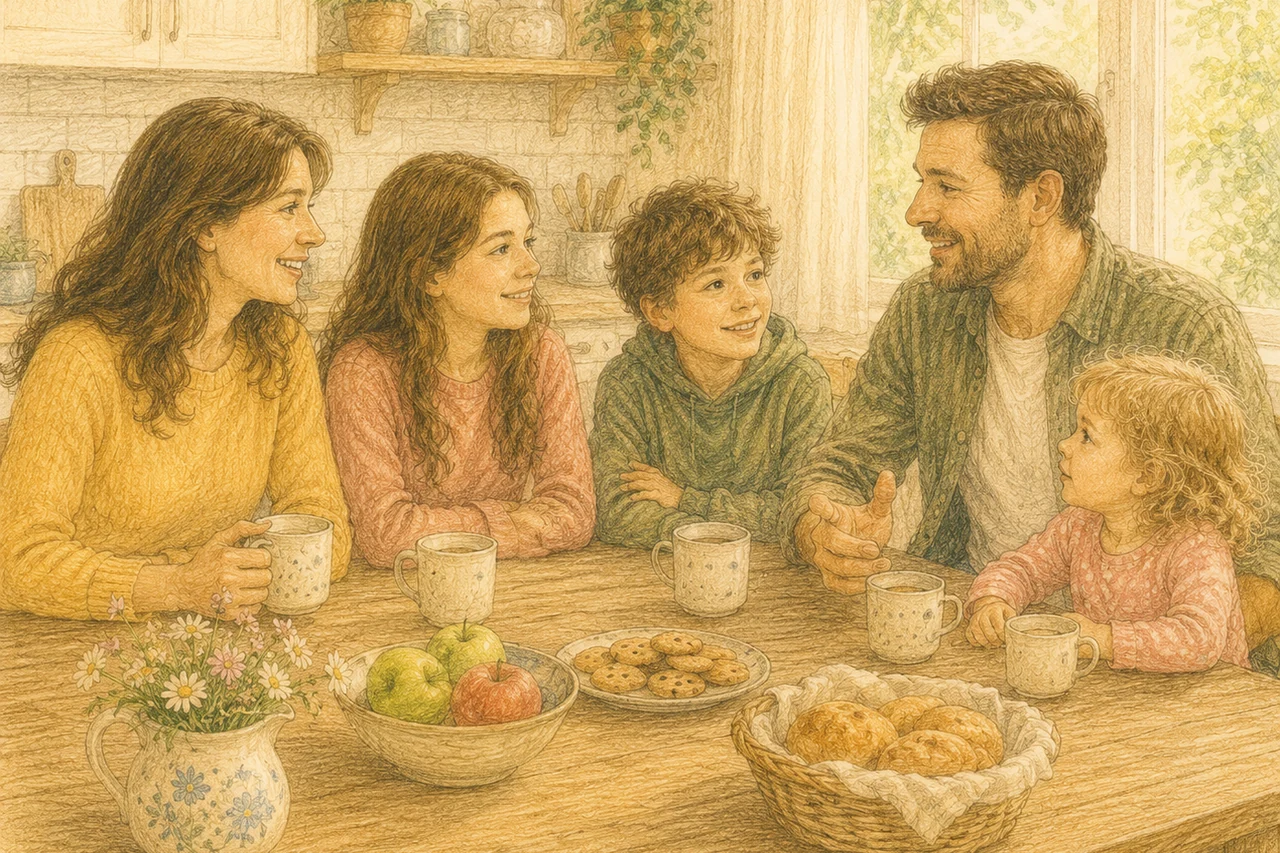
People love to talk about family dinner as a magic pill: gather at the table, and children turn out smarter, happier, and better protected. It sounds lovely, but the truth is more honest and more useful. What works is not the meal itself but the conversation around it. And that is great news: it means you do not need a perfect table every evening – you need five minutes of live, open conversation, which you can arrange anywhere. Below is why that is so, plus three simple questions with no right answer that grow both thinking and connection.
In short: it is not the food, it is the conversation
Shared dinners are linked to good things in children – but largely because families who eat together tend to be closer to begin with. In rigorous studies the "dinner effect" noticeably melts away. What holds up firmly is this: a live, open conversation develops language and thinking. Dinner is simply a convenient, regular occasion for it to happen. Breakfast, the car on the way to school, or a bedtime chat will give the same effect. Five minutes and three good questions matter more than the table setting.
Honestly about the "magic of family dinner"
Headlines promise a lot: children who often have dinner with their family have a larger vocabulary, better grades and mood, and less risky behaviour in adolescence. All of this is correlation, and here is the important honesty: when researchers account for the fact that "families who eat together" differ on many other traits too (closeness, resources), most of the "magic" disappears.
The work of Musick and Meier (2012) is telling: on a large longitudinal sample (about 18,000 adolescents), under rigorous methods, the strong "raw" associations largely dissolved – roughly half or more were explained by family resources and relationships, not by the fact of the dinner itself. In other words, what is behind the benefit is not the plate but warmth and closeness.
Separately: the frightening figures of "2 to 4 times higher risk of drug use without family dinners" come from CASA, an advocacy organization, drawn from survey reports without rigorous adjustment for misleading factors. They should be taken as an illustration of an inflated narrative, not as proof.
As Anne Fishel (The Family Dinner Project, Harvard) puts it: "the main secret of dinner is not the food at all." Dinner is simply a reliable moment when conversation happens. And the conversation can be moved wherever it is convenient.
What really works: the conversation
Here the science is actually solid – and this is exactly our theme of "questions that grow thinking." What matters is not what you eat, but how you talk.
A long study of language and literacy (Snow, Dickinson, and colleagues) showed that in preschoolers, future vocabulary, coherent speech, and early literacy are predicted not so much by reading as by "extended talk" at home – explanations, stories, conversation about what is not currently in front of you. The dinner table is surprisingly rich for this: according to Beals and Snow, mealtimes bring out a lot of rare, "grown-up" words (not from the first three thousand most frequent) – by Fishel's estimate, roughly 10 times more than on a playground. And there is simply a lot of live conversation at the table – far more than during the reading of a book.
Important emphases (and they are also our approach):
- Open questions beat closed ones. "How was school?" – "Fine" grows nothing. "What was interesting / hard today?" – gets thought going.
- Follow the child, do not interrogate. What matters is not "running through a list of questions" but picking up on what the child said and asking further.
- An honest caveat: the link between language and conversation is observational (it "predicts," it does not "guarantee"), but it is the most well-founded and most "mechanistic" part of the whole story.
Three questions
Each does its own job, none has a single right answer, and each adapts to age (2 to 14). One common rule: the adult answers too – honestly and briefly – and hands the word back to the child. The goal is a back-and-forth conversation, not a "question-and-answer."
1. "Rose and thorn" – connection and reflection. What was good today (the rose) and what was hard (the thorn); you can add a "bud" – what you are looking forward to. This invites the child to tell a story about what is not in front of them (that same extended talk) and tells the child "I am interested in how your day went." Everyone answers, including the parents – no one is "under interrogation."
- 2 to 4: "What made you happy today? And what upset you?"
- 5 to 9: the classic rose / thorn / bud.
- 10 to 14: "Rose, thorn, and something that surprised you" – and then on to the "why."
2. "What would you do if…" / "What if…" – thinking and imagination. For example: "What would you do if you were in charge of the school for a day?", "What if animals could talk – who would have something to say?" This shifts from "what happened" to hypothesis and explanation: you have to build an argument, imagine the consequences – exactly the kind of thinking with no right answer that Wings is built around. And it feels like a game, not a test.
- 2 to 4: "What would our dog say if it could talk?"
- 5 to 9: "What would you invent to make the morning easier?"
- 10 to 14: "What would you change in your city? And what could go wrong?" (we introduce trade-offs).
3. "What have you changed your mind about?" / "What are you thinking about right now?" – curiosity and one's own opinion. This invites explanation and a genuine opinion – and gently shows that changing your mind is normal and good. "I wonder why…" has no right answer by definition, so the child leads and the adult follows.
- 2 to 4: "What did you not like before, but like now?" (food works great here.)
- 5 to 9: "What are you especially curious about right now?"
- 10 to 14: "What opinion have you changed recently, and what convinced you?"
No guilt
- You do not need dinner every night or a beautiful table. What works is conversation and connection, not a perfect table setting. The bar is not "the perfect family dinner."
- Any regular moment will do: breakfast, the car on the way, a walk, the time before bed. What does the work is the habit of live, open conversation – five minutes is enough.
- Skipped an evening? No big deal. In a rigorous sense, skipped dinners are not a "risk factor"; the habit matters more than any single meal.
What not to do
- Do not turn it into an interrogation or an exam. A hail of questions, "so what is seven times eight?", and quizzing about grades kill that very back-and-forth conversation.
- Do not frighten with statistics. Scary "N times higher risk" figures are advocacy numbers, not cause-and-effect proof.
- Do not "catch them out on a mistake." If the child answered in one word – that is fine. Connection matters more than content.
Frequently asked questions
We cannot manage to have dinner all together. Are we missing something? Probably not. The benefit is in the conversation and the closeness, and you can arrange those over breakfast, in the car, or before bed. You are not losing a magic window.
My child answers in single words. What should I do? Answer yourself – briefly and honestly – and ask open "what" and "why" questions, not "yes/no" ones. Follow what interests them, do not push through a list.
Does it really make children smarter? Be careful with "make." A live conversation predicts richer speech and thinking, but families who talk this way differ in other ways too. It is more honest to put it this way: an open conversation is definitely useful and definitely within your power.
From what age should I ask such questions? From the very youngest – just simplify the wording. Even a two-year-old can handle "what made you happy?"; a teenager, "what have you changed your mind about?"
How Wings helps
Wings is, in essence, one good open question a day, ready for a conversation. If you do not have a question of your own on hand, we hand you one – tuned to the child's age (2 to 14), with no single right answer. We also give age-based book and video reviews and suggest how to discuss them: this is a convenient "external" way into a conversation. The personal does not always land right away – but discussing a book's character or a film's plot is easier, and through that the personal opens up on its own. It is the same "engine" as a good conversation at the table: not to test memory, but to wake up thought – and to be close along the way. Five minutes a day, no screen. Try it free →
Sources
- Musick, K., & Meier, A. (2012). "Assessing Causality and Persistence in Associations Between Family Dinners and Adolescent Well-Being". Journal of Marriage and Family (PubMed). (Under rigorous models the strong associations largely melt away; the benefit is driven by family resources and closeness.)
- Dickinson, D. K., & Tabors, P. O. (Eds.) (2001). Beginning Literacy with Language (ERIC) (Home-School Study; Snow, Dickinson, et al.). (Extended talk at home predicts vocabulary and literacy.)
- Snow, C. E., & Beals, D. E. (2006). "Mealtime talk that supports literacy development". New Directions for Child and Adolescent Development (PubMed). (Lots of rare words at the table; explanations and stories.)
- Weizman, Z. O., & Snow, C. E. (2001). "Lexical input as related to children's vocabulary acquisition". Developmental Psychology (PubMed). (There is a lot of conversation in daily life and at meals; rare words matter.)
- Fishel, A. – The Family Dinner Project (Harvard / MGH). ("The secret of dinner is not the food"; the "rose, thorn, bud" technique; the estimate of "rare words ~10 times more".)
- Systematic reviews (caution with causality): Skeer et al. (2016); "What can families gain from the family meal?" (2020) (ScienceDirect); Nutrients (2023).
- CASA (National Center on Addiction and Substance Abuse, Columbia University). "The Importance of Family Dinners" reports. Advocacy survey reports – not cause-and-effect proof.
Updated: July 2026.
Try Wings free
Free trial, then a monthly subscription.