Creativity – The No. 1 Skill of the AI Age (and How to Grow It at Home).
Wings Team
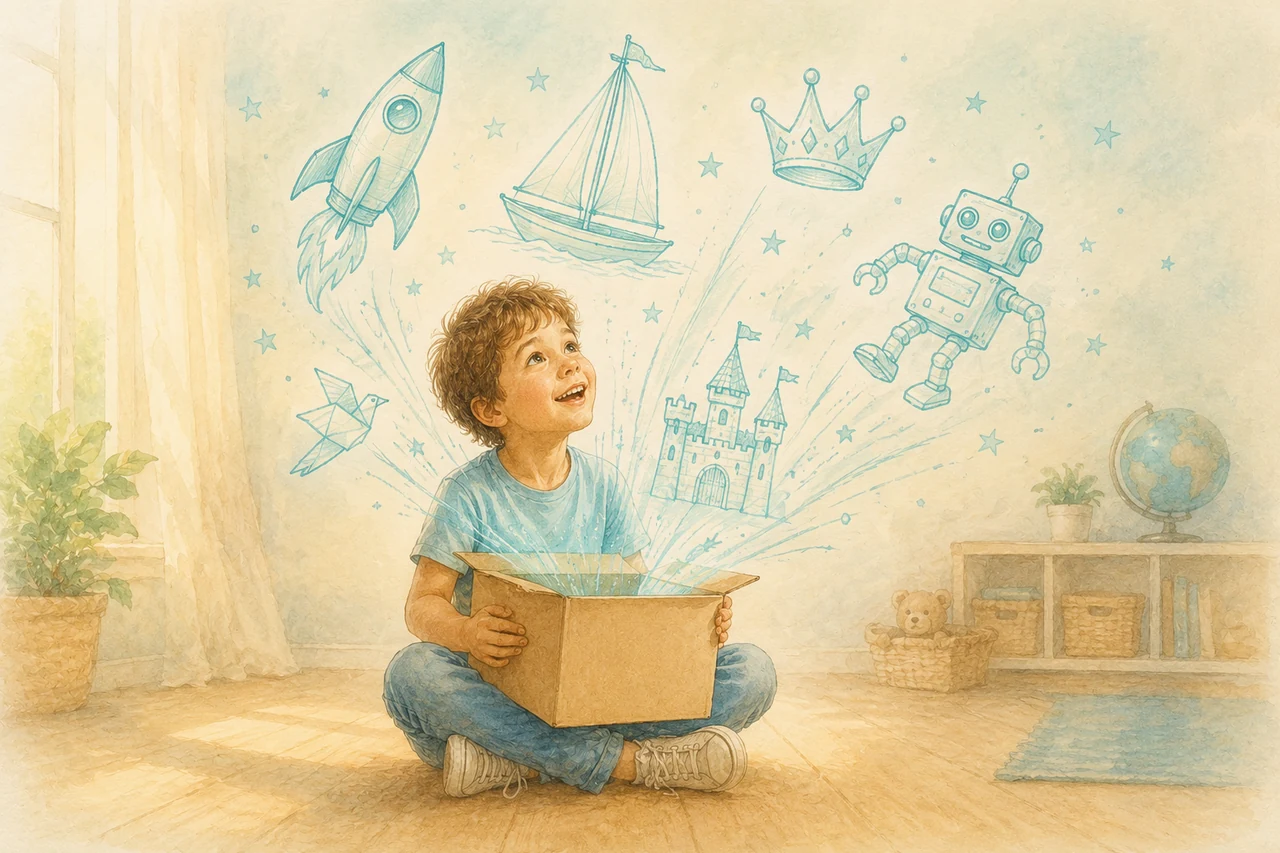
There are two harmful myths about creativity. The first: "it's an inborn talent – you either have it or you don't." The second: "to develop it, you need expensive classes." Both are wrong. Creativity is a trainable skill, and you can grow it at home, from whatever's on hand, in five minutes a day. And here's the thing – it's the very skill rising in value fastest as machines take over the routine.
In short: what creativity is and why it's rising in value
Creativity isn't "a talent for drawing" – it's the ability to generate many different ideas and pick the good ones. Psychologists call it divergent thinking: not one right answer, but ten different ones. That's exactly what a machine doesn't do for us yet – and exactly what employers rank near the top of the skills list. The good news: divergent thinking trains like a muscle, through ordinary home games, with no classes and no cost.
What the numbers say
The World Economic Forum surveys employers every year on which skills matter most. In its 2023 report, creative thinking came out as the No. 1 skill rising in value – flagged that way by 73% of companies (note: that's the share of companies, not "growth of 73%"). In the same report's ranking of "core skills today," creative thinking sat in second place, right behind analytical thinking.
By the 2025 report the picture had shifted: rising to the top of the fastest-growing list were AI and big data, cybersecurity, and technological literacy, and creative thinking dropped to fourth. But here's what's telling: even when technical skills lead, creativity holds a spot in the top five on both lists – its value isn't falling; it simply stopped being the only thing "on the rise."
Why is that? Because automation is happening in parallel. The classic estimate by Frey and Osborne (Oxford, 2013) said that about 47% of US jobs fall into the high-risk category for automation "over some decade or two." Honesty is needed here: this is not a forecast that "47% will vanish," but an estimate of how technically susceptible occupations are; a later OECD study, using a "task-based" approach, produced a far more modest ~9%. But neither approach disputes the direction: the routine and templated gets cheaper, while what machines do worst – inventing something new, connecting the unconnected – gets more valuable. That's creativity.
What's under the hood of creativity
People often think creativity lives in the "right hemisphere." That's an oversimplification. Modern brain research (Beaty, Benedek, and colleagues, 2016–2018) shows something else: a creative idea comes from the coordinated work of two brain networks.
- The default mode network – switches on when we daydream, "have our head in the clouds," let thoughts roam. It generates raw, unexpected associations.
- The executive control network – evaluates, selects, refines: which of the ideas actually works.
Creativity is when both networks work in tandem: one generously throws out ideas, the other picks selectively. Two practical conclusions follow at once. First, boredom and "doing nothing" are useful – it's precisely in that unfocused state that the default mode network hands you ideas (which is why the best thoughts arrive in the shower or on a walk). Second, creativity needs both phases: first "throw out a lot with no criticism," then "select and polish." If a child gets corrected on the very first idea, the second network drowns out the first, and the flow shuts off.
There's also a lovely direct confirmation that the body affects ideas. In an experiment by Oppezzo and Schwartz (Stanford, 2014), people generated about 60% more original ideas while walking than while sitting – and the effect lingered for a while after the walk. Movement literally revs up idea generation.
The worrying news: creativity is easy to lose
Young children have divergent thinking in abundance – they aren't afraid of the "wrong" answer. But research shows that over the school years this skill often declines: an analysis by Kyung Hee Kim (2011) of Torrance Tests of Creative Thinking recorded a drop in children's scores over recent decades. The cause is understandable, and it isn't "bad schools": by design the system rewards a single right answer and a fast pace, and there's almost no time for "how else?"
The takeaway for a parent is simple: creativity doesn't need to be "installed" – it's already there. It needs not to be squandered, and to be given room. And here the home has a huge advantage over the classroom: no grades, no "right/wrong," all the time in the world to think.
How to grow creativity at home (with no classes and no cost)
Everything below is divergent-thinking training. There's one rule: first throw out lots of ideas with no criticism, and only then choose. There are no "dumb" options – the weirder, the better at the generating stage.
1. "What would happen if…" The best game in the car and at dinner. "What would happen if people didn't sleep?", "…if rain fell upward?", "…if animals could talk?" There's no right answer here – only imagination and the logic that builds it out. Exactly what a search engine won't do.
2. "Five ways to get ice cream." Take any everyday goal and ask for not one but five ways to reach it – from reasonable to utterly wild. Count out loud: "that's one… that's two…" The point isn't to solve the task but to train "fluency" – the ability to produce many options rather than getting stuck on the first.
3. One object – twenty uses. A classic exercise from psychology (the Alternative Uses Task) works beautifully as a game. "What else could you use a paperclip for? A brick? A sock?" Whoever comes up with the most unusual wins. This is literally the very test that divergent thinking is measured with in the lab.
4. On-hand materials instead of ready-made toys. A box, tape, bottle caps, an old sock – and the question "what can you make from this?" A finished toy offers one scenario; a box offers infinity. The less a toy "does" on its own, the more the child has to invent.
5. Improvisation: in movement, in sound, in words. Here's the honest framing: we're not promising that "dance and music make the brain smarter" in general (science rates the far transfer to other skills as modest and contested). But improvisation itself is direct creativity practice:
- Improv dance – "show me how a robot / a jellyfish / a storm moves." Inventing a movement that isn't in the model is divergent thinking in the body (there's research linking creative dance to cognitive flexibility and executive function in children; effects are modest but real).
- Improv music – tap out your own rhythm, invent a melody for a word, "voice" what sadness or rain sounds like. What's valuable isn't "a musical education" but the very act of inventing sound.
- Making up stories and poems – "let's invent a fairy tale where the hero is our kettle," rhymes at speed, continue the story from any point. This is the most direct trainer: inventing a plot is exactly the same creating-something-new, just in words.
6. Walking and boredom are work, too. Remember the two brain networks: ideas arrive in the unfocused state. Don't rush to fill every free minute with a screen or a class. An aimless walk, cloud-watching, "I'm bored" – that's not emptiness but the very phase where ideas are born.
What helps and what smothers creativity
| Smothers | Grows |
|---|---|
| "There's one right answer" | "How else could you? Come up with five options" |
| correcting on the very first idea | throw out a lot first, criticize later |
| every minute filled (classes, screen) | room for boredom and a walk |
| ready-made toys with one scenario | on-hand materials with no instructions |
| "that's silly / that doesn't happen" | "interesting, and what next?" |
| praising only the result | noticing the unusual line of thought |
What a parent can do
- Ask questions with no right answer. "What would happen if…", "how else?", "come up with five ways." Five minutes a day is enough.
- Don't criticize at the generating stage. Let there be lots of ideas first, even wild ones. Selection comes later. The first criticism shuts off the flow.
- Protect boredom. Don't fill every pause. The unfocused state is a working state for ideas, not wasted time.
- Give "unfinished" materials. A box beats a ready-made toy. The question "what can you make from this?" is worth more than any kit.
- Value the unusual move, not just the correct result. "How did you get to that?" is the best praise for creativity.
- Model your own. Invent out loud together, get it wrong, laugh at the wild options. The child learns that creating is normal and safe.
Frequently asked questions
Is creativity an inborn talent? No. The ability to generate different ideas (divergent thinking) can be trained in any child through ordinary games. "Talent" is most often simply a skill that was given room and wasn't smothered.
What if my child "isn't creative"? They most likely are – the skill has just gotten used to hiding wherever everything is graded. At home, where there's no "right/wrong," it usually comes back quickly. Start with "what would happen if…" – it works almost every time.
Do you need special classes? Not necessarily. A class can offer an environment and inspiration, but training creativity itself requires neither money nor equipment – only questions with no right answer and the freedom to invent something strange.
Do dance and music really develop thinking? Honestly: the "far transfer" – that music or dance makes a child smarter overall – is rated weak and contested by science. But improvisation in movement, sound, and words is direct practice of creativity itself. What's valuable isn't a music-school diploma but the habit of inventing.
Won't this get in the way of schoolwork? Quite the opposite. The ability to ask a question, see a non-standard solution, and connect distant things helps in math and in essay writing alike. And in a world where the machine fetches the facts, this is precisely what stays on the human's side.
How Wings helps
Wings is essentially a daily trainer for that same divergent thinking. Every day, one short task or question for the child (ages 2–14) with no single right answer: they have to invent something, offer a few options, look from another angle. We grade not correctness but the quality and originality of the thinking – and we do it with no grades and no pressure. Five minutes a day, screen-free. Exactly what's rising in value while everything else gets automated. Try it free →
Sources
- World Economic Forum. Future of Jobs Report 2023 (May 2023). (Creative thinking – No. 1 among rising skills, flagged by 73% of companies; No. 2 among core skills.)
- World Economic Forum. Future of Jobs Report 2025 (January 2025). (Analytical thinking – top core skill; creative thinking – No. 4 among both core and rising; AI and big data lead.)
- Frey, C. B., & Osborne, M. A. (2013/2017). "The Future of Employment: How Susceptible Are Jobs to Computerisation?" Technological Forecasting and Social Change. (~47% of US jobs in the high-risk category; a susceptibility estimate, not a loss forecast.)
- Arntz, M., Gregory, T., & Zierahn, U. (2016). "The Risk of Automation for Jobs in OECD Countries." OECD Working Paper No. 189. (Task-based approach: ~9% of jobs highly automatable – an honest counterpoint to the 47%.)
- Beaty, R. E., Benedek, M., Silvia, P. J., & Schacter, D. L. (2016). "Creative Cognition and Brain Network Dynamics." Trends in Cognitive Sciences. (Creativity – interaction of the default mode network and the executive control network.)
- Guilford, J. P. (1967). The Nature of Human Intelligence. (The concept of divergent thinking.)
- Oppezzo, M., & Schwartz, D. L. (2014). "Give Your Ideas Some Legs: The Positive Effect of Walking on Creative Thinking." Journal of Experimental Psychology. (Walking boosts idea generation by about 60%.)
- Kim, K. H. (2011). "The Creativity Crisis: The Decrease in Creative Thinking Scores on the Torrance Tests." Creativity Research Journal. (A decline in children's creative-thinking scores.)
Last updated: July 2026.
Try Wings free
Free trial, then a monthly subscription.